

 Elia Gonzato
Entering a new journey usually comes with new experiences, which can live up to expectations or, more likely, make people realise the importance of overlooked aspects of this path.
Two weeks before I started my journey as a PhD student I was thinking about the challenges that I was going to face and I mainly thought about methods, formulas and numbers. It took me slightly less than a month to understand that I didn’t have the picture clear in mind.
Starting to climb the learning curve
The first thing I learned was the importance of reading. I was initially bored by the idea of reading for the first weeks or months, but I later learned that the key part that precedes ‘action’, is positioning. It is impossible to define where I’m going if I don’t know where I am. I also noticed the uncertainties of the world of science and found out that, sometimes, the body of work that is put out isn’t necessarily published to explain what a group of researchers understood, but what they didn’t.
I was once reading a paper about the recommended variance estimator for a specific matching procedure and the author himself stated: ‘the proposed estimator can be used until an improved version is developed’. Even though I finished the article with more questions than when I started reading it, I was happy to read that there is work to do. What I initially pictured as a frenetic rush of analyses after analyses, suddenly turned into an unstable walk into unknown territories. At that point, I wasn’t only confused, but fascinated too.
The second ‘reality check’ I faced, were presentations. I was aware of the principle ‘prepare your slides based on the audience’, but I later figured out I didn’t understand it completely. The first presentation I prepared was not too general, but it was also not targeted at the people I was explaining it to. There were not enough figures and/or animations and, more importantly, there were no examples, or at least not the right ones. “Why would you use data from the past?” or “Are there examples of this approach being welcomed?”, and even though I was the one who was supposed to know about the topic of the presentation, I had no idea how to answer. Sometimes, making up a random example doesn’t work as well as picking a published one, which works even better if it’s (in)famous, be it due to positive or negative publicity.
Communication and the value of listening
Next, I learned the importance of communication. Just like life, (applied) research is about compromises: we tend to look at a problem from different angles, and then we try to meet in the middle. The latter is the tricky part. Because I was used to my own way of thinking and reasoning, I struggled to see the other side of the coin and often got stuck to a point where the main issue was the lack of communication.
The first step to ‘ meet in the middle’, is to use the same vocabulary, so both parts involved in the conversation immediately understand what the other is referring to. It happened a bunch of times to discuss for quite a while about two different things, which later turned out to be the same one, just because those were addressed with different names.
A great example for this is the terminology used by statisticians to define the follow-up time for participants. The term ‘time zero’ if often used to point out from which moment in time a patient becomes at risk for a certain event of interest. However, for medical doctors this term is very broad and can hint at: the moment when the patient had their first symptom, the moment in which the patient had received a diagnosis or when included in a cohort or database. This simple but very common example illustrates how using a different vocabulary can make it surprisingly hard to make sense of things or reach a clear decision.
Similarly to reading, this step requires learning first, before putting into practice. To become good communicators, I believe we first need to be good listeners.
My takeaways so far
One suggestion I think is worth giving, is keeping a diary of our daily work and interactions. I often wonder how I would explain all this to the ‘myself of the past’, the one who was trying to prepare for the beginning of the journey, and I think it works the other way around, as the one from the past can explain to the one of the present by writing.
Similarly, you can see this as commenting code that you might have to use in six months, which otherwise would be difficult (if not impossible) to comprehend. That feels like a lot of work, but you can keep it brief. Just a couple of sentences every day, about what worked, what didn’t and why, that’s sufficient. Reading those few lines after some months makes me connect the dots and realize what in the moment felt weird or difficult to explain. And, if I got it correctly, once I have understood certain dynamics, I should be able to understand when I am in similar settings.
In the end, I also understood the meaning behind ‘keep trying’. I initially felt shy and counted every wrong step taken, only to find out that the more I made, the more suggestions I would receive and the more I would improve.
One thing I promised myself was to enjoy the ‘meantime’ more than I did in the past. I have always worked towards certain goals, like passing an exam, graduating or publishing a paper, but I hardly enjoyed the moments in between. I found out that the funny part about research is not publishing itself or seeing the results of something you have been waiting for months or years, but the moments that take you there. Up to now, I think I am living up to that promise. I have had the opportunity to work on a clinical trial and the parts of the process I enjoyed the most was not the actual analysis, but coding simulations of all possible scenarios, the back and forth with the clinical team after each meeting and the discussions that eventually ended up in sounded decisions, which came months before.
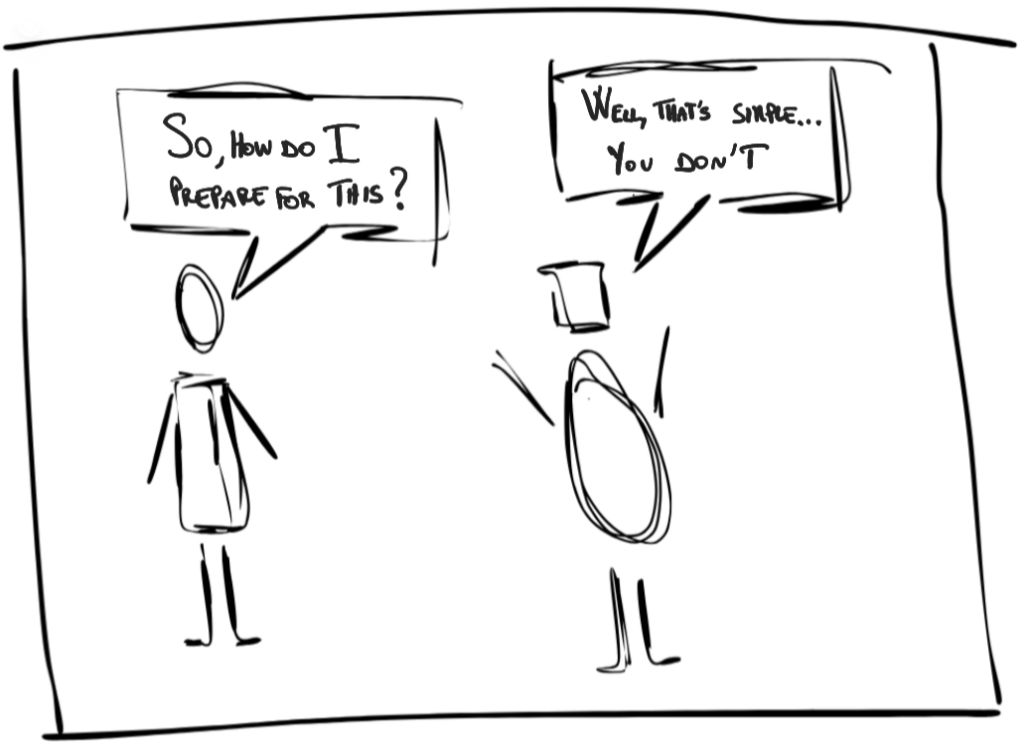
I still haven’t figured out how to prepare in advance for something, because probably we cannot, but I feel it’s important to be ready in the middle of the story.
Foto: Freepik


 Mark van de Wiel

 Caroline Jagtenberg

 Bernard Zweers
 Miriam Loois
 Simone Griffioen


Add comment